Average Every Day Skier
:date: 2026-11-24 20:15
Yesterday we got our first snow of the year.
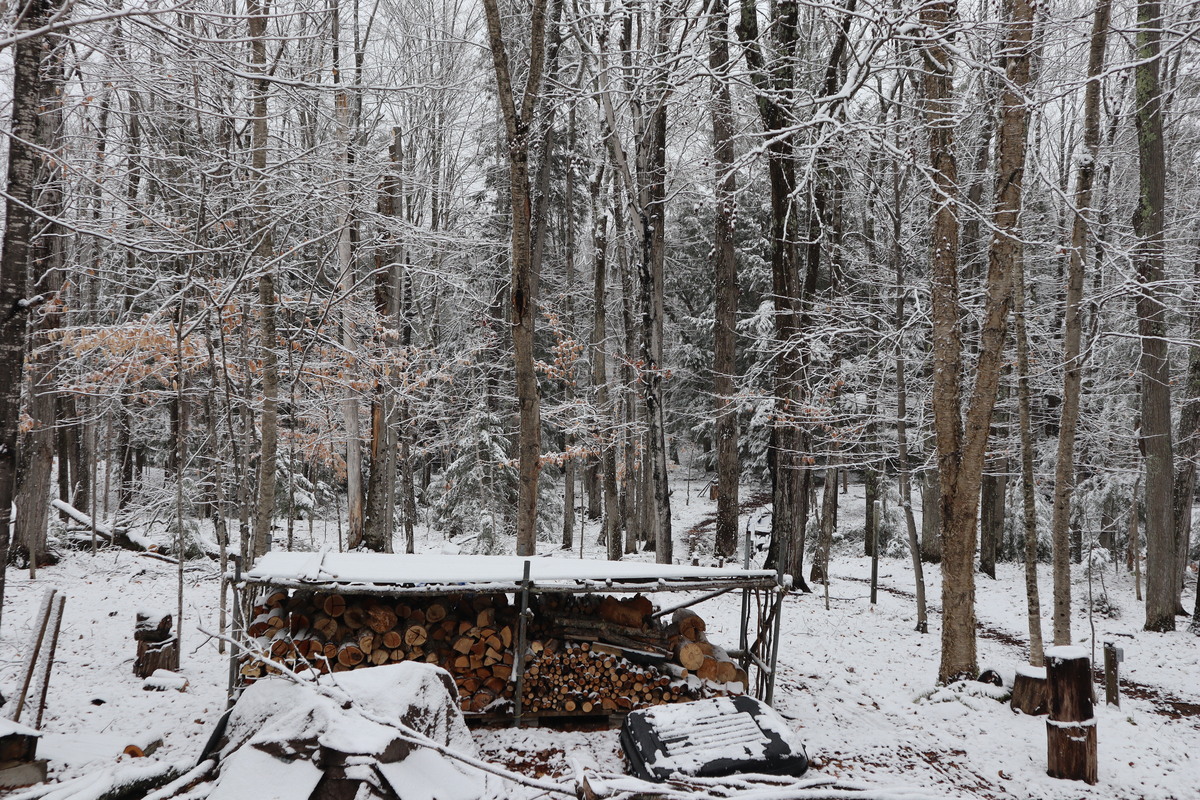
It was not much and the ground was warm but it was enough that I could get out and ski a lap of my 1km ski trail. I also managed to ski it this morning too. I suspect it will melt and I'll be back to rollerskiing but it is a sign that we are now firmly in the 2026/2027 ski season. For normal skiers, it is obvious by about June what year's ski season it currently is: if all the snow is gone, the season is over.
For me, it's a little more complicated. I arbitrarily use November 20th as the start of my ski season. The reason is that the last day I did not ski was November 19, 2024. On November 20, I start a new year of continuous days of skiing. I have just completed my second complete year of skiing all of the days. In the last two years, there are no Olympians or professional ski racers who have skied more days than I have.
Is this sensible? Certainly it is not the optimal way to go fast or win races. But I do feel like it is close to optimal for someone with the goal to simply "enjoy skiing".
Everyday I log some facts about my ski outing. When I first started this I just wanted a rough idea of how often skiing was possible. But as the entries piled up I had vague ideas that maybe the data would be interesting some day. Eventually I got a fancy watch that told me speeds and distances and heart rate, etc., and I recorded all that too. At some point I started to dread the massive job it would be to extract any meaningful insights from this huge mess of data. If only I had a team of interns who were freakishly good at data management. Ah ha! In 2026 we all have such a team!
Last year I wrote about the extraordinary 24/25 ski season and that was a lot of work. This year I did some very minimal cleanup to all my training logs and just handed them to my robot friend, Claude, who has impressed me with software skills this summer. I asked it to see if it could decipher my cryptic notations and come up with any insights which it could show graphically. And I think it did a pretty good job! Better than I was going to do. So let's take a look at my ski history.
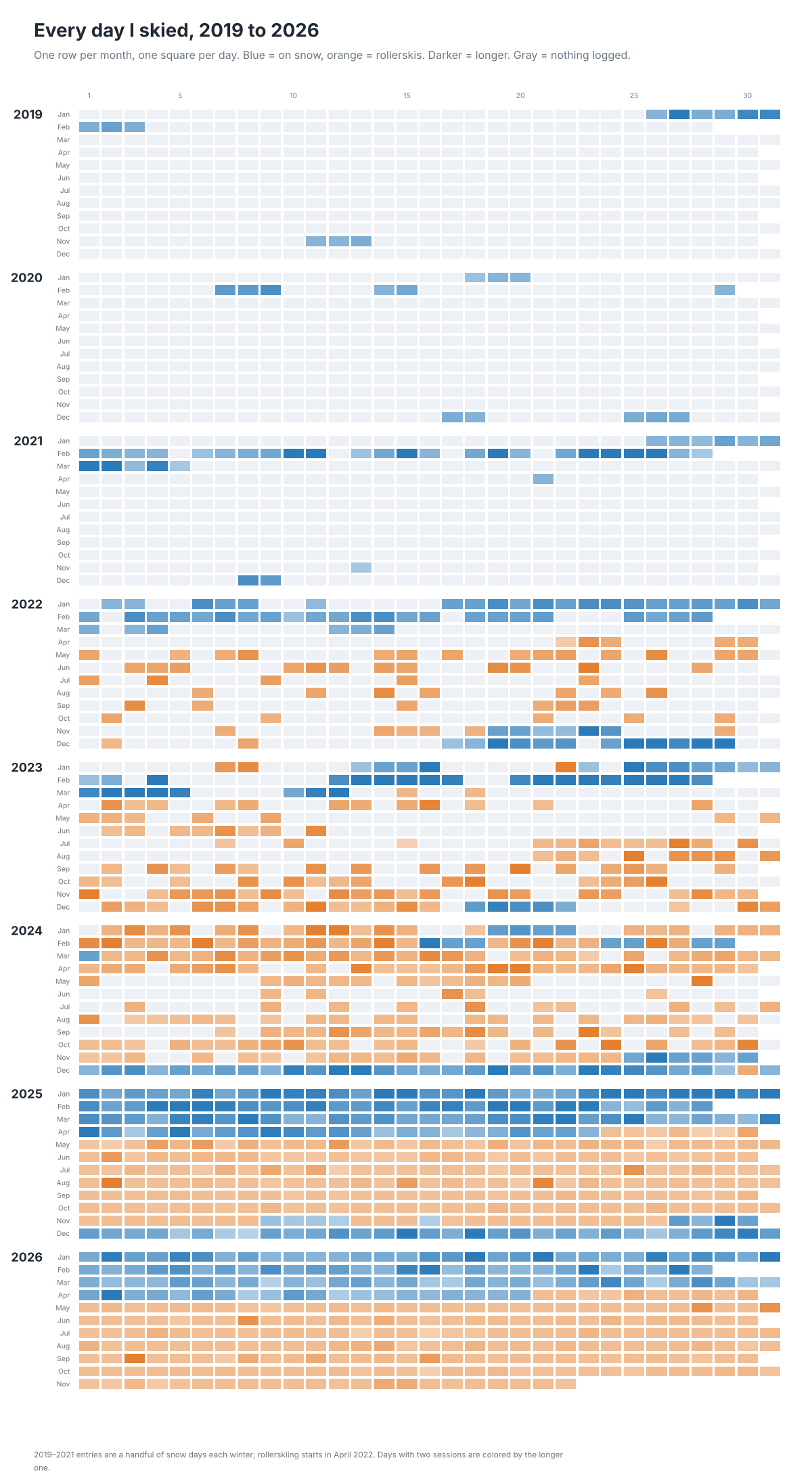
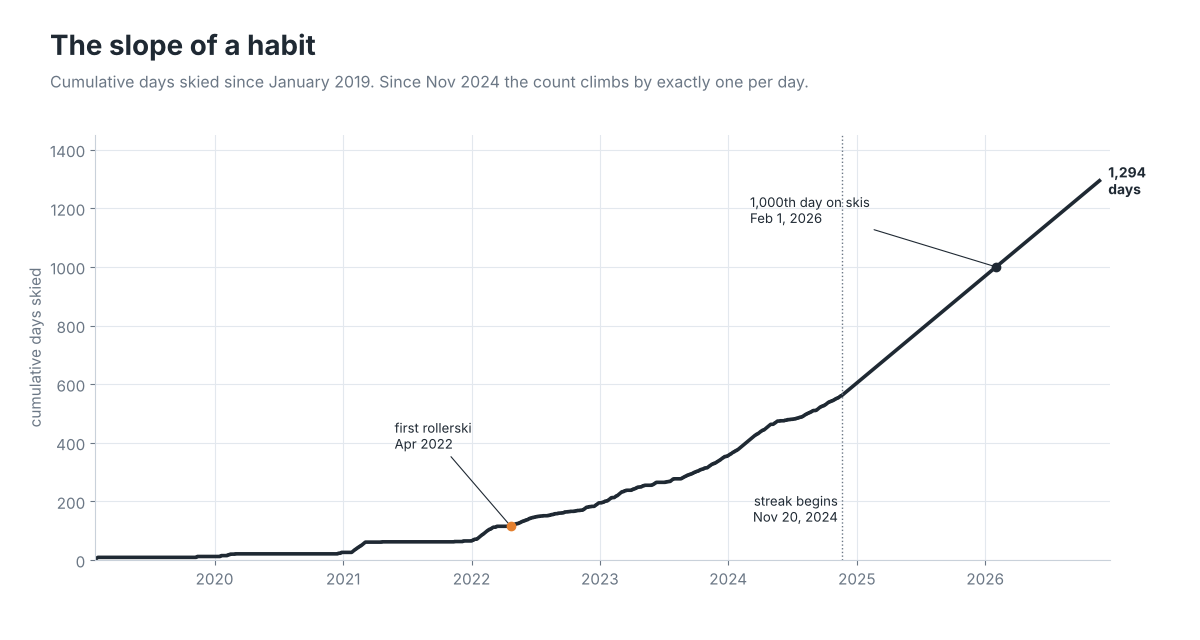
The first plot is really the main story. I started XC skiing again in 2019 after a forced 40 year break since skiing in Alaska as a kid. Thanks to learning as a kid, I was instantly good at it which helped make it enjoyable. I steadily figured out ways to maximize how much I did it.
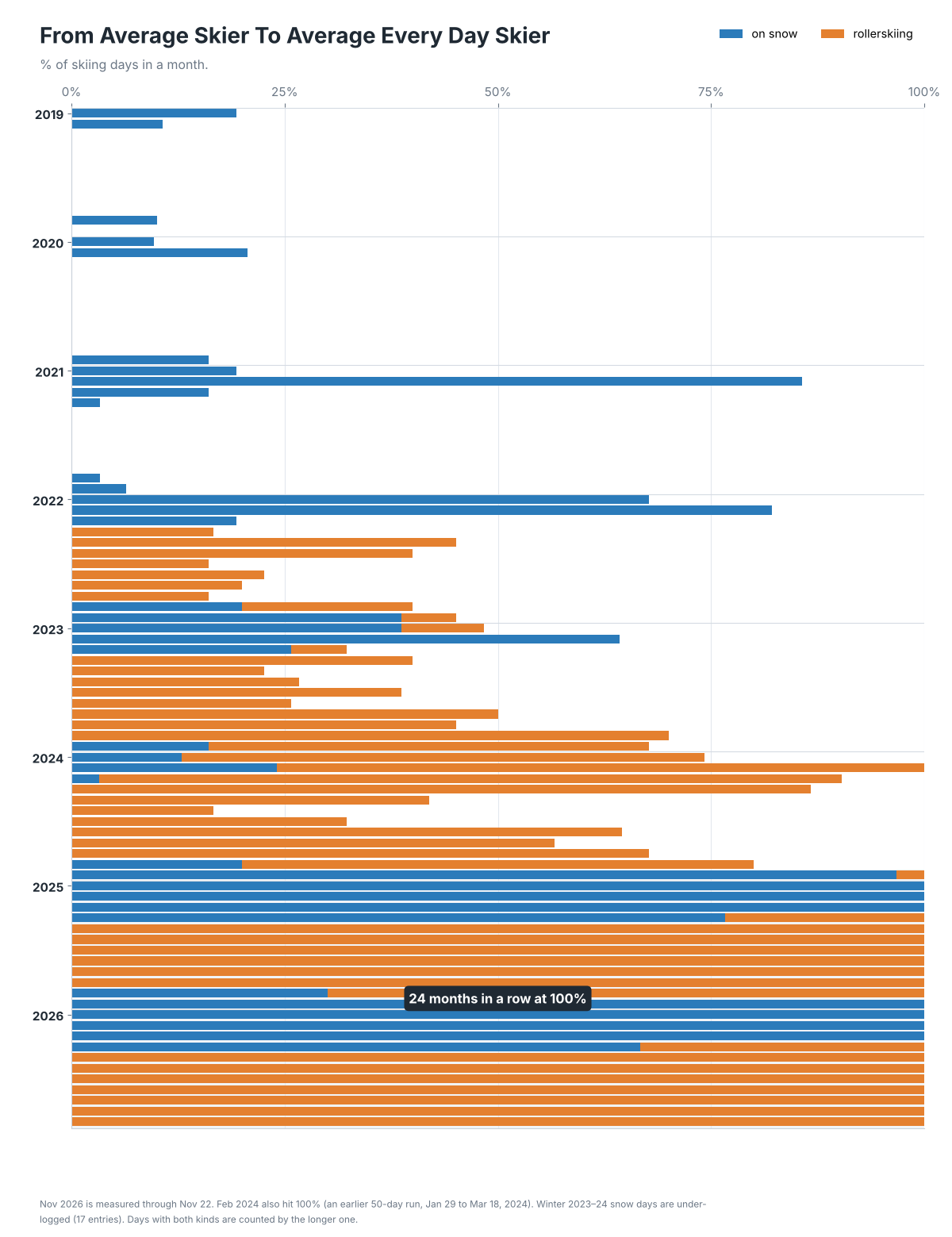
The interesting thing about this next plot is that it shows when I adopted the rule: "If there is snow that can be skied on, then there will be skiing." By the end of the 2019-2020 season I had realized that you can not take days off just because you feel lazy. There are simply not enough days with sufficient snow for luxuries like that. I feel like normal skiers ski about 10 days a year and would like to ski another 10 but they let the chances slip away. The blue bars are percentage of the month skied on snow, but they are not the percentage of possible skiing days. Starting in 2020, that has been 100%.
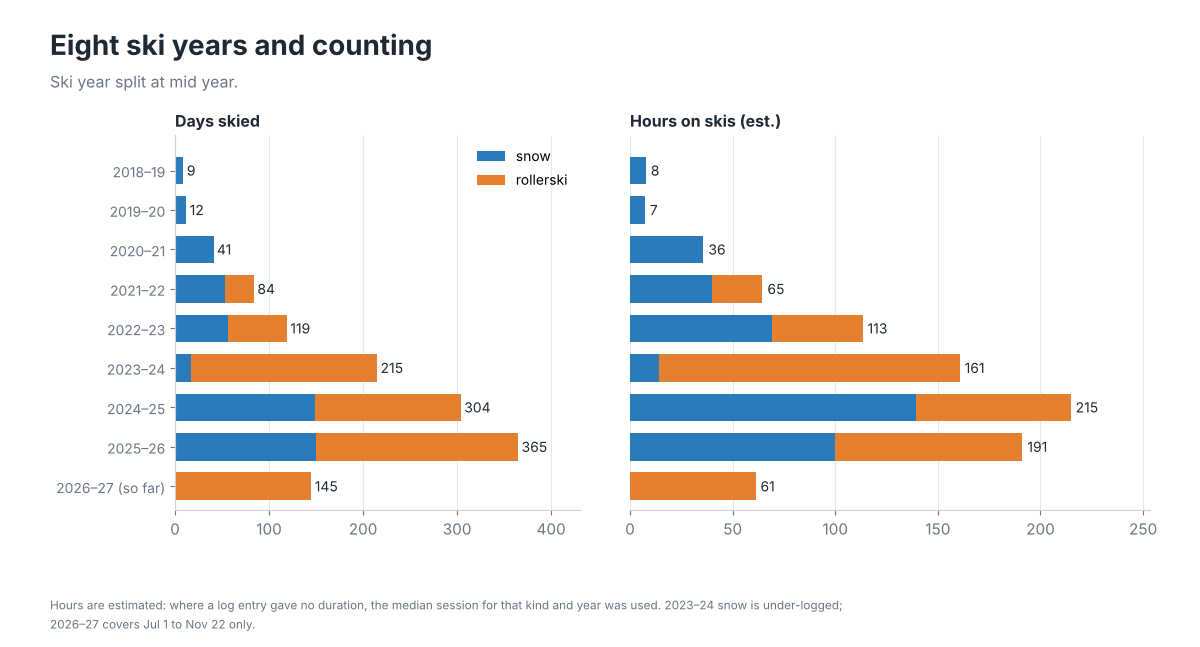
The interesting thing about this next plot is the hours. I was surprised to see the 24-25 season crack 200 hours. To put this in perspective, professionals who get away with the least training put in about 400 hours. 600 to 800 is normal for pros. Pros who really invest in long hours max out at about 1200 hours per year. Normal skiers are doing well to hit 10 hours.
This is a cool plot. One day this will level off. But it's never going down!
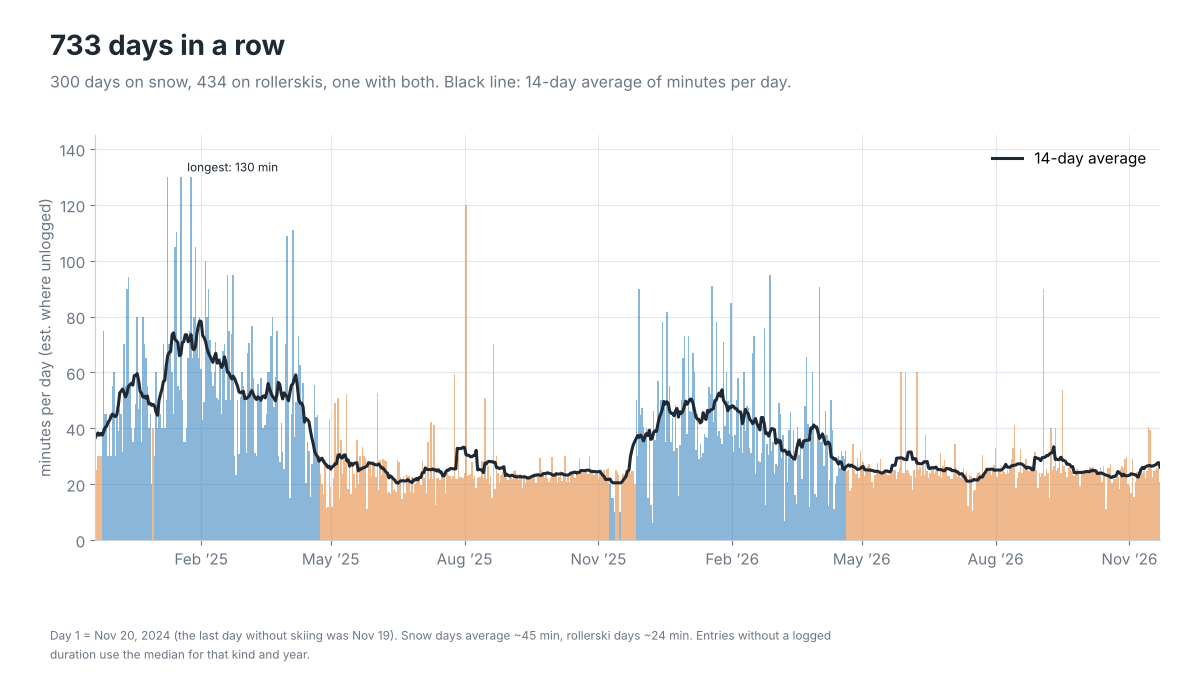
An interesting look at the duration I skied each day. The 24-25 season was my first in Michigan and I was exploring the area as much as I could. A lot of that was fun but a lot of it was also a slog. Last winter I had prepared a ski trail on my own property and was content to do laps on that quite a bit. Also last year there was a lot of snow and slogging through fresh deep snow is hard work. My rollerskiing time seems pretty light but I usually am going pretty hard. A good way to think of it is that it feels like the same effort as running a 5km race every day. If I ran like that every day, my body would be destroyed. The nice thing about skiing is that it is low impact and persistent high wattages are sustainable even for old guys like me.
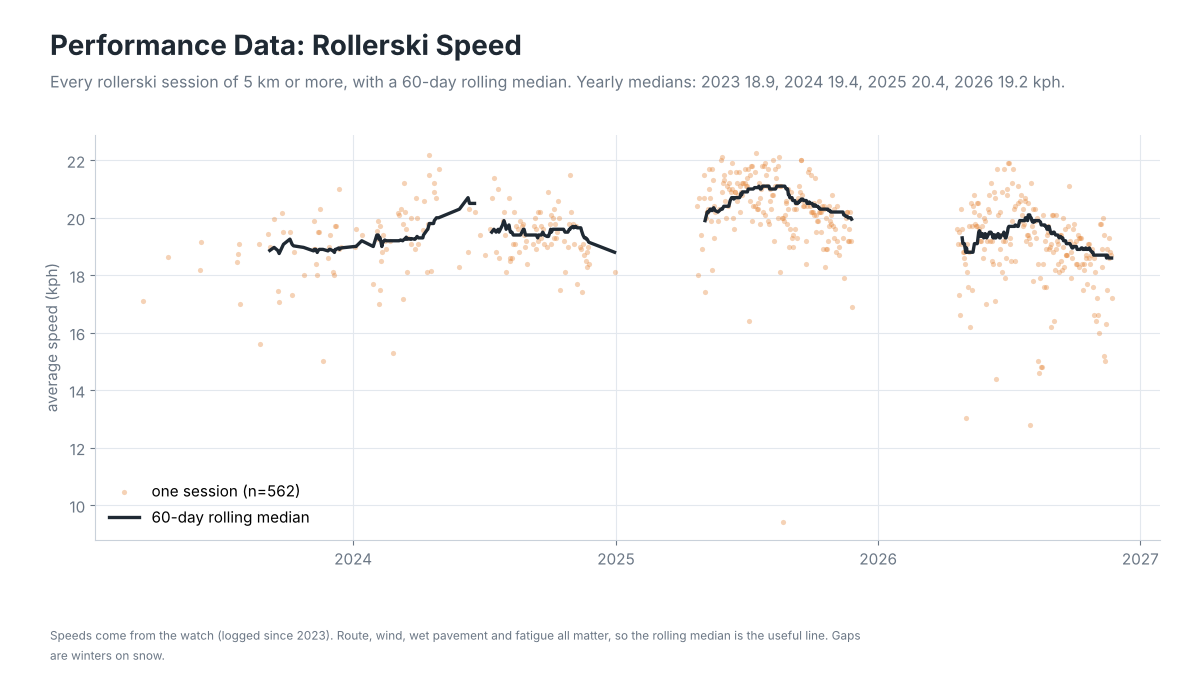
This one is interesting to me. It shows why I think I should be faster than I am this year. Maybe I'm getting older and weaker. Maybe I'm just tired from a lot of other activities that are tough on the body. I did change my form slightly at the end of 2025; it seems like a big improvement but maybe not so much! Hard to say. But interesting to see it.
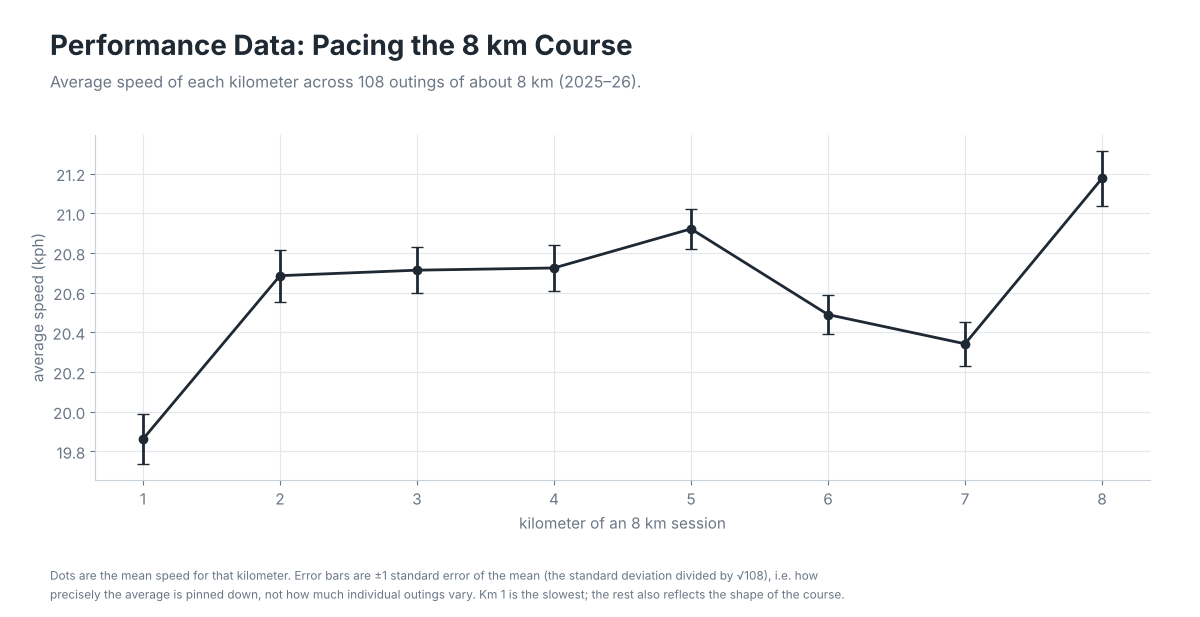
This one is interesting because I'm kind of used to seeing this pattern but with so much data it is quite in focus. A big element here is that I tend to choose a direction to fight the wind at the beginning of my outing so I have a tailwind coming back. But my courses turn quite a bit halfway to the turnaround so, it's complex. Maybe a bit of very slight elevation change being noticeable too with so much data.
This is also interesting because I have noticed that rather than get stronger all rollerski season, I seem to peak and then get worse for the few months leading up to snow. If I was a racer, this would be a real problem! I have hypothesized that as it cools, I have a harder time warming up and that I have more breathing problems like congestion. It could be simply windier at this time of year. I wear more clothes and just the difference between wearing tight lycra shorts (summer) and running shorts (autumn) can cost between half and one kph. (N.b. soccer players and runners!)
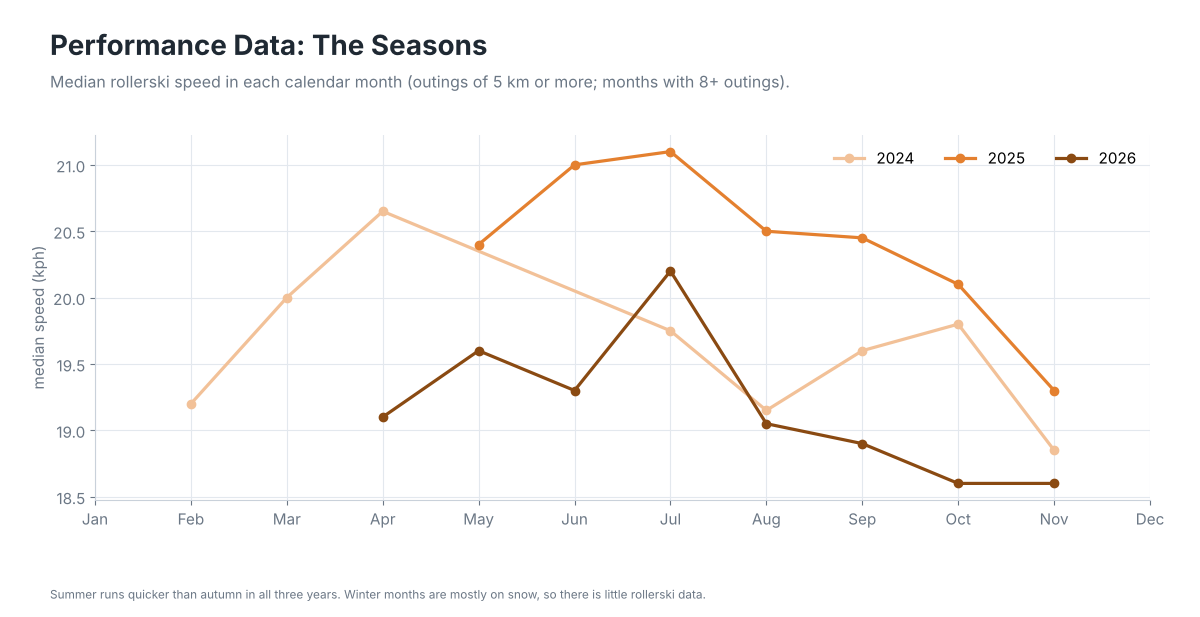
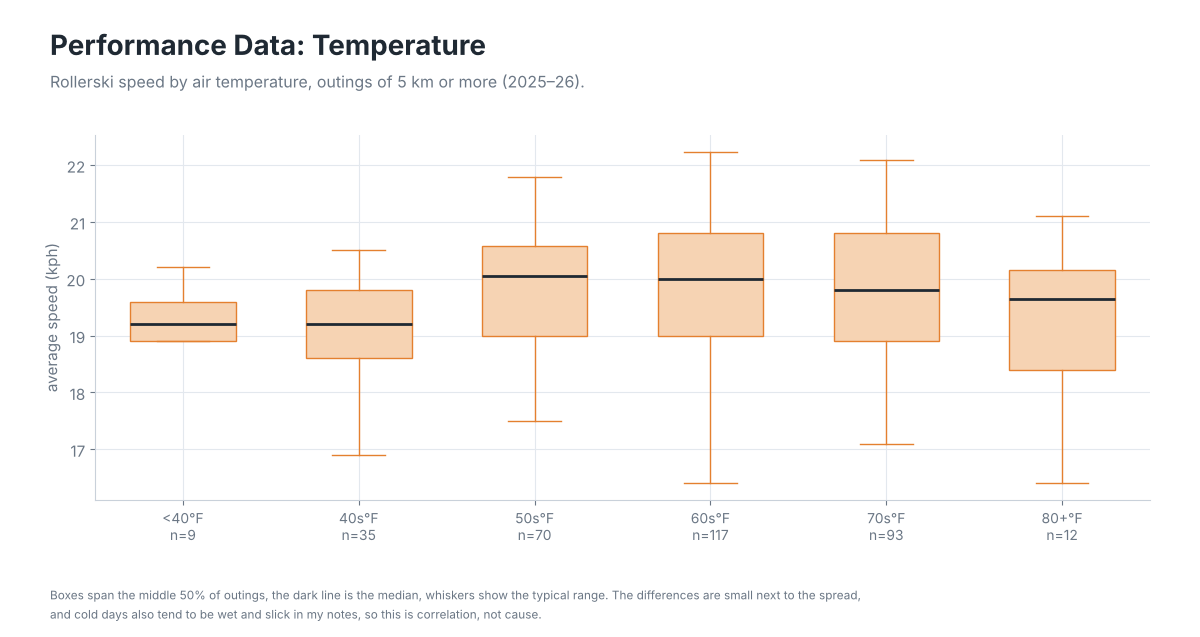
Here's a more detailed look focusing on the temperature. Cool, but not too cool seems to be ideal. Could also be correlation and not causation.
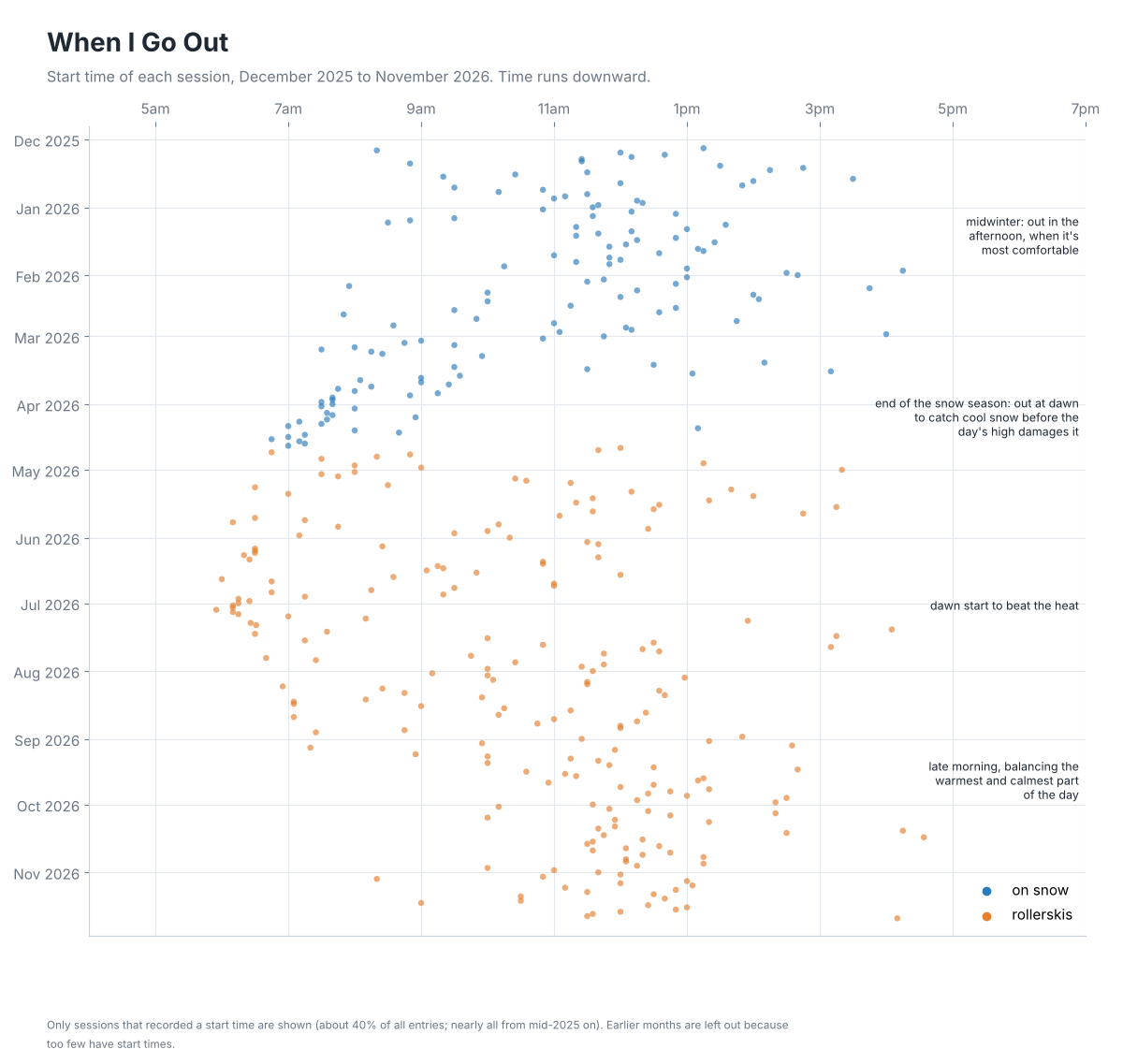
I am lucky to be able to plan my day around skiing and so this is pretty much a look at what the optimal time to ski is. And by going out every day, yes, I am an expert.
Here are some stats from the two streak periods. Note that it is my Nov 20th cut off and not the normal ski season around a certain winter. If we went with that, because I had 5 days before Nov 20 that were credited to the first streak year, I actually had exactly 150 days on snow both winters. The reduction in kms and hours really is mostly due to too much (ungroomed) snow. That tended to keep me on my little 1km ski track. The snow last winter was even too much for snowmobiles to get up to their normal mischief.
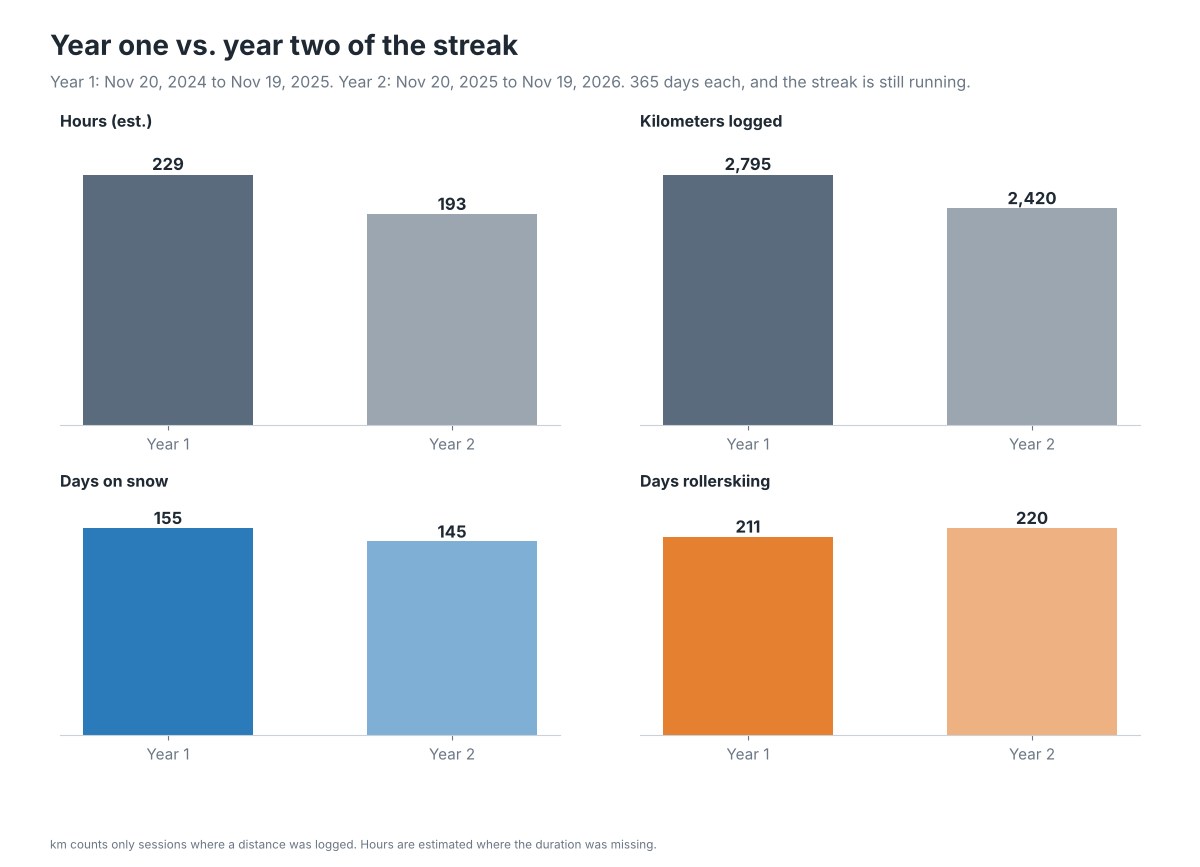
Obviously this data is mostly interesting to me, but it is also a cautionary look at what can happen if society somehow fails to prevent people from doing what they enjoy doing.