Synxro
:date: 2026-11-22 08:31 :tags:
Jimi Hendrix never had any formal musical training. He could not read music at all and yet he did fine musically. I suspect people like that are rare and what is certain is that I am not one of them.
Just noodling around with a guitar is not ever going to make someone refrain from asking me to stop. But I do like musician LARPing! What can I do to break past that skill barrier where people actually don't mind hearing me play?
Not only is my playing painfully bad but I am also even worse at musical improvisation. Fortunately there is a solution that promotes the necessary skill practice while removing the need to extemporaneously compose music at all. I am talking about musical literacy. Reading music is a powerful skill, even if Hendrix couldn't do it.
In my late teenage years, I tried to get more serious about music. I spent a lot of frustratingly ineffective effort to learn to sight read guitar music. It was discouragingly hard since I wasn't as naturally gifted at that kind of literacy as I was with the regular kind.
In 1992 I saw an ad in a computer magazine (which is how we learned about computer things back then) for a computerized system to teach one how to play the piano. It was called the Miracle Piano Teaching System.
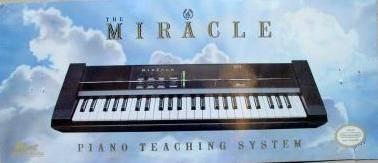
As a more naturally talented computer nerd who understood the benefits of music sight reading, this was very interesting. I immediately bought one and after about three months of reasonably diligent practice with it, I went from nearly zero musical score reading ability to playing two hand piano music from sheet music. I was no virtuoso concert pianist but I was doing the basic hobby. I eventually sent the system to my mother and she also transformed from a zero skill piano player to a non-zero skill one. This system worked! It really was a miracle.
Specifically what massively accelerates the learning process is having a computer give you feedback that is constant, instant, and perfect. The Miracle system did not just crudely check in on how you were doing during your weekly half hour lesson. It perfectly monitored every note ever played and communicated instantly how that went. It was a night and day difference.
I still remember my mentality shifting from "What's wrong with this stupid program?" when it flagged a note I knew I had played correctly to "Ok, it's flagging a note I thought I played correctly but obviously I didn't." If I had to sort out misfires with a human teacher, especially the serendipitously pleasant sounding mistakes, it would have been a huge setback.
This experience filled me with optimism about the future of music education. Little did I suspect that we would enter a kind of dark age. It was puzzling and somewhat distressing to me that computerized music education was not gaining popularity. I did not notice any activity at all for a dozen more years. Then in 2005 the world of computerized music education was beset with a catastrophic disaster: Guitar Hero.
Guitar Hero was an anti-educational computer system that taught people how not to play a musical instrument and to have contempt for the entire concept. To me it was a painful squandering of an opportunity to actually teach people even a tiny bit about music.
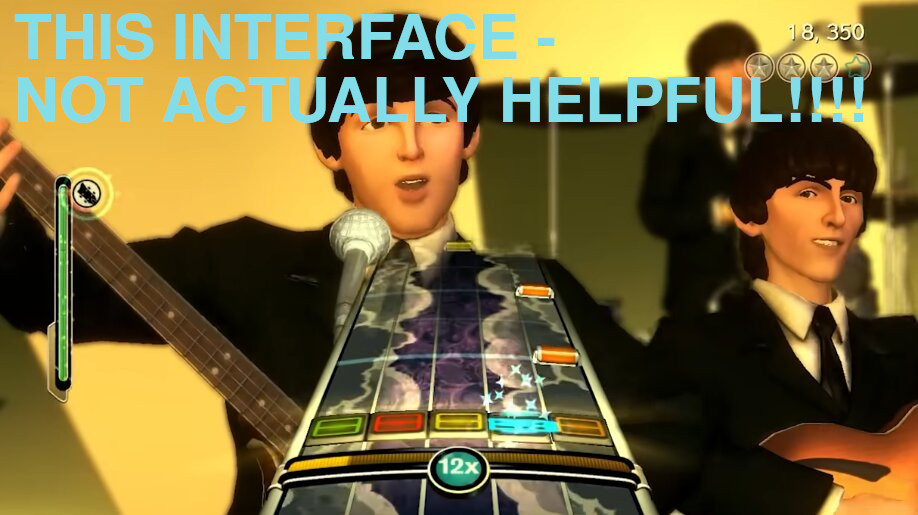
Around 2010 I became aware that a stupid Guitar Hero knockoff franchise called Rock Band had just released Rock Band 3. What caught my attention is that this "game" featured actual MIDI instruments including a guitar with 6 strings and 17 frets (102 fretboard actuations). Finally it seemed we were making a tiny bit of progress.
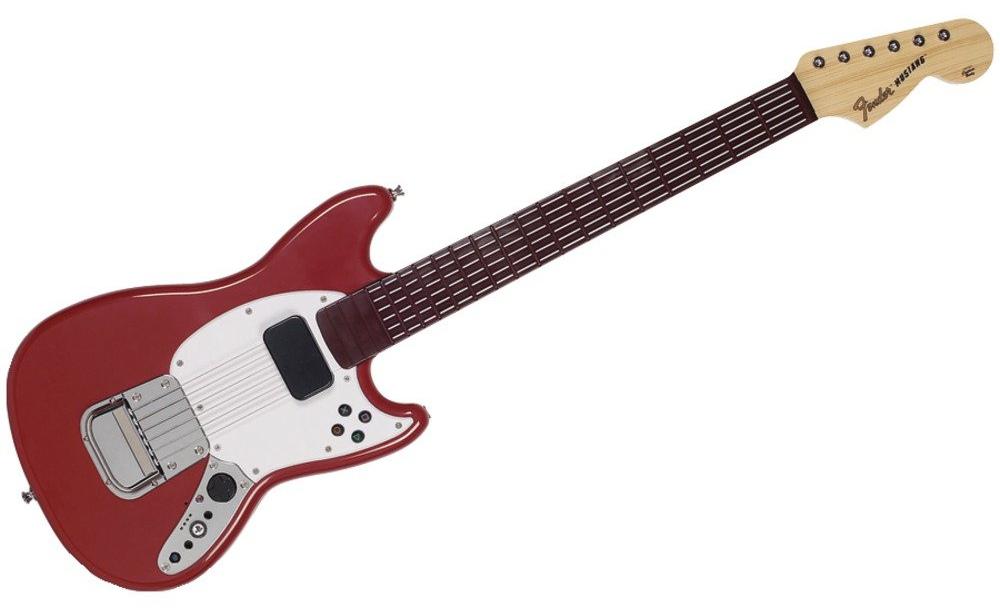
I bought this guitar (which I review here) and later a MIDI keyboard and a MIDI drum set. My household has been playing Rock Band 3 now for over 15 years. Yes, I still have a PS3 working just for this purpose.
While RB3 is not harmful to real guitar (or drum) skills, it is not exactly helpful either. And woe to someone who accidentally plugs the PS3 into a network and lets Sony brick it. This ancient game is not sustainable and it has always been unsatisfying in its tragic unfulfilled potential. (Rocksmith, also disappointing.)
In 2021 I reviewed a book about music learning challenges which I felt got it wrong and I wrote a digression about the kind of computerized music learning system I wanted. This is what I wrote five years ago.
If you’re a middle aged "guitar zero", all the equipment you need to painlessly learn how to read the vast corpus of written music is readily available. I have owned all of the necessary hardware for over a decade. What is missing is software.
As much as I personally would rather not be the person who writes this software, I've waited long enough and am not seeing much choice. Every few years I see if anyone has a decent system, and so far have seen nothing I like. These are my requirements for such software.
- Interface with a real 6 string guitar-like device with 15 or more frets.
- Monitor the playing of displayed sheet music, and provide instant feedback on any errors.
- An untimed mode where you can take your time just to learn the note placement.
- A timed mode with a beat (and optional metronome) where playing the right note at the wrong time (e.g. late) is also flagged as an error.
- The ability to set the tempo in timed mode.
- Allow custom music to be added to the system.
That really does not seem like a lot to ask. I actually did some work on this project earlier in the year. It's easy to procrastinate though because I keep hoping that someone else will beat me to it and make a sane obvious computerized system that helps teach guitar sight reading.
How's that for quasi-prescience? To my knowledge this has not been written by someone else while I've been procrastinating, but our robot friends have recently become sufficiently skilled at software generation that, with the right guidance, a project like this is now much more tractable. I am certain of this because in the last few weeks, my robot friends and I have created exactly this software!
This post introduces a project I call Synxro. (I'm studying Greek these days so humor me by pronouncing it "sin crow"; at least the namespace is pretty clean.) Synxro is basically all of the functional requirements I outlined in 2021. It is a drop in replacement for both the Miracle Piano System and Rock Band 3. The profound improvement, of course, is that the user is in complete control, which means that if you have the patience and/or technical ability to chart it, you can have any music you wish.
This post is just an introduction to Synxro to mark the accomplishment of the project's initial goals. I will have a separate post discussing the very educational process of managing some freakishly good robot friends to write the majority of the code. I will also have a post once I get a project page for it sorted out and published for public consumption.
While there was definitely a slight "vibe coding" element to this project, I have thought about this problem from a software standpoint for decades. And the core idea I came up with is really quite interesting — so interesting that LLMs would not conceive of it. One might think that to replace a music education system like Miracle there would have to be some sense of, well, music. But my critical insight is that knowing about music is a distraction to this kind of program!
The entire system is basically agnostic to any kind of specific application. It is actually a specialty game engine for interaction systems where user actuated events are related to scheduled events. For example, this software is ideal for a typing tutor program. It could be used for one of those old dance pad games or something like Beat Saber. It is essentially an abstracted detailed exploration of what gamers call quick time events. It turns out, reading music is nothing more than a very challenging QTE.
The system requires the preparation of content "packs". Packs contain "sheets" (static images only) which can serve as a sufficient prompt for "events". The classic sheet format would be actual sheet music scores (or guitar tab, etc., whatever works). Every pack has a "chart" where every "action" (e.g. "press note E4", "release E4", "change to sheet 2", etc) is scheduled with a time. In the chart, "regions" can be defined so that events can also highlight specific areas of the sheet. In this way, even though the system has no clue about the music, it can highlight what to play on the sheet at the correct time and know when to expect the user to play it. Input is abstracted so any kind of interface is possible (normal typing keyboard, MIDI musical instrument signals, other software, whatever you've got).
What I've described sounds oh so simple; that was deliberate and clever. The reality is that this software is a complex beast. The complexity is so difficult to convey, that even I have not fully absorbed it all. To provide a rough demonstration, I managed to record a play through of my main testing sample pack. I use the They Might Be Giants song ZYX because I roughly know it and it is easy to map to obvious typing key press events.
Some things to note about the demo.
- The notation is a simplified fake notation I whipped up by hand. Hopefully it is obvious how actual music could be swapped in. Just remember that the sheet can consist of anything, and any region can be highlighted anywhere at any time.
- I am playing this very badly. Seeing mistakes is helpful and interesting for testing and demonstration purposes. Um, yes, totally deliberate and not just a post hoc rationalization.
- Not only am I playing it badly, but I also charted it crudely by hand. The scheduled times aren't even quite correct adding to the error. Watch for the yellow region boxes to see when it thinks I should hit a scheduled event.
- The X signs are user events I am hitting that are not the thing I should be hitting. Or well outside of the plausible expected window. Basically a "WTF".
- A red box is instant feedback that I played something late. More redness, more late.
- A blue box is similar, but early.
- The first two H events are played about on time. Almost everything else is badly played.
- The two pages show how multiple sheets work. The "music" at the bottom of sheet one is just to help prepare you for the change to sheet two where it is repeated.
- This supports sustained notes (piano, guitar, etc) and also percussion (drums) which have no release events. This demo assumes percussion, e.g. a xylophone.
After the play through, a detailed summary is created.
chart "zyxtest": 47 events, 2 sheets, real time
# synxro-report 1
chart: zyxtest   mode: realtime   speed: 100%   pass: 1
timing: audio clock
windows (real ms): good 60, fair 150, outer 300

reached 47 of 47 events (stopped at 41.248 s)
  hit             4   on time 8%
  early           3   late 10   far early 3   far late 22
  wrong key       1   missed 4   played 89%
  spurious        7   (6 near miss, 1 stray, 0 off-chart)   doubles 0

timing (42 timed events, ms): bias +172   jitter 70   90th pct 243   max 288
  drift: rushing 140 ms per minute
  offsets (ms, negative is early):
     -300..-251  |## 1
     -250..-201  |## 1
     -200..-151  |## 1
     -150..-101  |## 1
     -100..-51   |####### 3
      -50..-1    |####### 3
        0..49    | 0
       50..99    |############### 6
      100..149   |########## 4
      150..199   |#################### 8
      200..249   |############################## 12
      250..299   |##### 2

worst sheets: page1 (22 issues), page2 (15 issues)
worst regions: r_j (3), r_y (2), r_s (2), r_q (2), r_i (2)

largest timing errors:
  3.750 s  Z late 288 ms   page1 r_z   chart line 46
  20.190 s  I early 280 ms   page2 r_i   chart line 69
  11.461 s  Q late 267 ms   page1 r_q   chart line 55
  14.716 s  P late 245 ms   page1 r_p   chart line 59
  10.984 s  R late 243 ms   page1 r_r   chart line 54

by token (most issues first):
  J: 3 issues (0 missed, 0 wrong, 3 far, 0 spurious), mean offset +196 ms
  S: 3 issues (1 missed, 0 wrong, 1 far, 1 spurious), mean offset +230 ms
  A: 2 issues (1 missed, 0 wrong, 0 far, 1 spurious), mean offset +87 ms
  G: 2 issues (0 missed, 0 wrong, 1 far, 1 spurious), mean offset +126 ms
  H: 2 issues (0 missed, 0 wrong, 1 far, 1 spurious), mean offset -103 ms

note: a steady offset of +172 ms against a spread of 70 ms may be output latency, or simply how you play; try --latency 172 if it persists across runs.
# end synxro-report
Also a complete record of all user events is kept so that it can be fed to subsequent analysis programs (along with the event chart) to help provide optimal feedback. Here is a plot generated by an auxiliary summary analysis program.
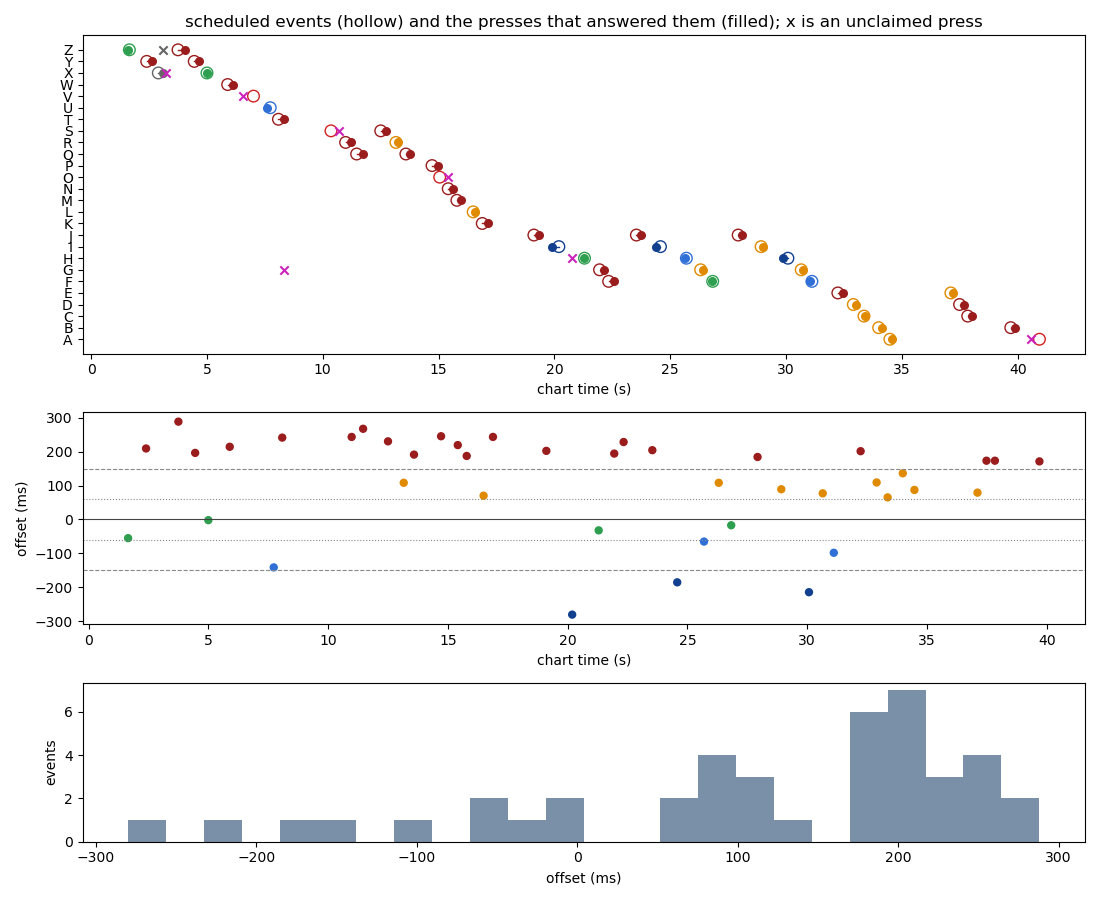
By the time we got to the recap summary feedback I was tired and just told my robots, "surprise me". I was hoping for a rough placeholder so I could think more about it. But damn, that is actually some shockingly good data presented reasonably well. From this you can clearly see there is about 150ms of systemic lag, perhaps from a charting misalignment. And it is clear the events where I simply over-anticipated the recording's pacing.
And that's it. Those are all the components needed to assemble a highly effective music education strategy with very scrupulous attention to detail.
Future
Of course there is much left to do. These results and the skill of my robot friends encourage even more ambitious goals. A lot of future work involves separate software that collaborates with this system.
- Metronome - A helper program which can produce accurate beat click tracks or, better, create tracks and charts from drum machine software like Hydrogen.
- Time Dilation - Helpers to prep time scaled practice versions. See the excellent Play It Slowly. Normal software (e.g. RB3) might allow certain levels of practice slowing, but since you're in complete control you can stretch out the events by 1000x or by 12.3456%, or whatever you exactly need.
- Concatenate - A helper to concatenate charts and to split them. Making short charts is obviously easier than long ones and breaking a larger piece into sections also gives the ability to practice just that section. But at some point you will want to assemble all the parts for a complete play through.
- Loop - An option is needed to allow repeating over and over. You know, the essence of practicing.
- Networking - The key upgrade of the Rock Band series over Guitar Hero was the band aspect — more than one player could be involved. Attention was given to the design to accommodate this but it is not implemented. Basically the clock reference of the master machine (which plays the audio) must be somehow published on a socket such that client machines can ascertain where exactly in the piece the performance is. I can already imagine my robot friends rushing off to reinvent NTP from first principles, but I think some fairly basic time cues should suffice. With that simple feature I think it should be possible for an entire orchestra to play together and get highly accurate feedback.
- MIDI - Now that I have seen the entire system work, I am confident that hooking it up to my MIDI instruments will be worthwhile. This basically involves creating suitable map files for my MIDI guitar, drums, and keyboard.
- Magical Input - This is the age of AI miracles. My value added is shifting to having the vision of what is possible. If I played a guitar in front of a professor at a music conservatory, she could tell me many of the mistakes I was making. How is this possible without MIDI data? Well, the normal way. A human teacher can listen to what I'm playing (which is the important bit) and they can also watch my hands play. It turns out that computers can now listen very well to complex semantic sounds. Voice recognition tells us that "what notes were played on a guitar" recognition is also very likely possible. Probably easier. And my work with vision systems tells me that computers should also be able to watch musical performances and reconstruct exactly what was played. Combine the two for extremely high quality accuracy. Another can of worms that magical input might solve is exactly voice recognition — vocals.
- Magical Charting - One important application of AI input is in creating the chart packs. Probably the biggest deficiency I have musically is not being able to know exactly what my favorite music actually requires to be played. This is why sight reading sheet music seems like such a valuable skill to me. But what if you want to play some obscure performance of something that has no transcription? And even if you can find a halfway decent guitar tab of the song, it sure would be better to not have to bother. Aiming the magical input system at recorded music could create the canonical standard to practice to achieve exact album fidelity.
- Normal Charting - Creating the packs, especially the charts is a big job. So big that by ignoring it, I was able to make much more progress. But it was ignorable precisely because it can be done with completely separate helper programs. Already I have a small helper program that just dumps events with millisecond time stamps so I can roughly create an event list manually. But this could be improved quite a bit. A side note to anyone who thinks this kind of software will take music teacher jobs: I hope so! But it should allow music teachers to change focus precisely to creating the custom charts that their students want. (And of course the human expression side of things.) Presumably pros can play the song that the student can't. So having a helper program record a skilled pro is a good way to manually create charts. And there is also automatic (but not magical) chart creation. There is a lot of (e.g. classical) music which is already nicely computerized. It should be possible to extract the events based on musical first principles. I can imagine something that uses Rosegarden in someway to convert true music semantics to events, something we know it already does internally.
That is Synxro, a piece of software I have dreamed about for 34 years, finally real. I will post more as development continues (though I might take a little break). Let me know if there is some interesting feature of music education that you can think of that I am missing. These days, we can probably fix that!