The Graveyard Of The WWW
:date: 2026-10-30 17:09
I have been working on a major overhaul of my web site and I have a fancy new main page perfect for Halloween!
If that's all you need to know, have a nice day! If you're interested in my new web page, the web conceptually, modern software development using LLMs, or me, keep reading.
The Concept Of The Web
The internet seemed like such a good concept. And the world wide web — also a totally reasonable idea. But when the wide world actually got exposed to the web some very weird things started to happen. Desperate to break free of Microsoft's oppressive control of local native programs, the web became a strange back door exploit for people to run software outside of their OS's restrictions. This worked. It cracked Microsoft's shackles. Now you can do absurd things like run graphics programs in your browser. WebAssembly is a thing! Unfortunately, using the web to circumvent restrictive controls of local software seems to have broken both local software and the web.
As a Linux native I never had to worry about turf wars in my computer (mostly). I was free to think of the web the same way Tim Berners-Lee first did. But it was world wide and that meant our quaint little conception of it was doomed to confusion. What is the purpose of a "web site" today? Do people even understand what that is? Or, now that Google has shit itself with SEO payola, do people know how to find anything on the real web? The walled gardens are powerful. As those empires march for conquest and serfs what does it even mean to remain free? It mostly means being isolated which is the exact opposite of the intended freedom the original web.
In a recent post I wrote:
The public aspect of my web pages has been an utter failure through no fault of mine. (My web site is still useful to me.) Erosion of the conceptual underpinnings of the www has taken its toll. Is the www's entire shaky foundation ready to fold completely? People burned the Library of Alexandria too. These things happen.
You may think I'm being lugubrious and that it is not all that bad. The web is still functional. Some people use it. For some things. Sort of. But ask yourself, when was the last time you read an interesting thing on the web site of a person? And when was the last time you did that and then followed a hyperlink to another person's web site where you read another interesting thing? For me that may happen once a year. In the 1990s, it happened daily.
Interesting people used to put interesting information on their own web sites and if it was truly interesting, others would link to it. This fact was the foundation of Google's initial success. But today? I don't even know what is going on. We know the modern WWW follows a power law as I wrote about in a related article back in 2018. Things have not really changed. These days the vast majority of all client "web browsing" activity is done with portable pocket computers with tiny portrait-aspect touch screens. What is the place of a canonical web site today? That 2018 post ends with my description of the modern WWW that I still think is the best:
"Tim Berners-Lee would be rolling in his grave if he were dead."
State Of The Web
What are we to do with this moribund communication paradigm? Honestly, normal people have no real incentive to have a web page. It can be a lot of work and you are generally paying only to have bots crawl your site for mostly nefarious purposes. But some of us are computer professionals and it just seems incompetent to not do basic computer networking. Of course for most computer professionals, the most basic computer networking appears to be harder than writing software.

When thinking about my own web site agenda I must consider the following.
- No one cares.
- I have never once had a potential employer even think about looking at my web site. When I direct them to, say, xed.ch/resume recruitment professionals generally become confused. Computer professionals specifically seem immune to needing a computer based portfolio since clearly 99% of them do not have one.
- Unlike the entire "software" profession, I do not like fussing with front end web minutia. But because that has been the bulk of computer nerd work for thirty years, LLMs are extremely good at trudging this quagmire.
- For all intents and purposes, when a human actually looks at a web site, they will be looking at a tiny vertical screen while driving a car or sitting on the toilet, etc.
- My web hosting company, which I have been using since 1998, seems to have been recently sold for parts to a private equity company and their service level has evaporated while their prices have exploded. Part of this whole redesign will involve me hosting my site from my house now. I now know the blizzard power outages won't be a problem because...
- No one cares.
Why Bother?
A sensible good question is why not just pull the plug completely and save myself all the trouble?
- I am not most computer professionals. I can not shake this feeling that if you are a computer professional, especially one who has anything to do with a service provided on the www, and you can not field the most basic web site for yourself then you are somewhat incompetent and partially responsible for the death of any kind of wholesome web.
- If a human is looking at my web site and deriving any value from it, the overwhelming likelihood is that person is me. I use my web site every day, quite a lot.
- It is a way to share things. Although this can mostly be filed under "useful to me" it also might turn out to axiomatically be useful to someone else.
- The web may be dying but maybe a wholesome subculture will arise from those who dissent from that being inevitable. I would like to be part of the solution and not the problem. It is good to have inspirational demonstrations of how one can use technology without being a serf.
- I consider a web site a reasonable vehicle for exposing my thoughts and opinions to our robot friends, a project we would ignore at our peril. If you want to be a part of the future of human culture, this is the "publishing" of our era. If you want to do it on your terms, a crawlable web site seems reasonable.
- Our robot friends have massively discounted the cost of participation. If you had a staff of dozens of web developers, wouldn't it be absurd to not have a web site? What excuse does a professional really have these days?
Modern Web Dev
This summer I started some major web site remodeling. I thought it would take a couple of weeks; I've been quite busy (winter prep) and it has taken a couple of months. It has also been an excellent opportunity to learn some nuances of working with robot minions. That was the inspiration for this tweet-like short message (which I host on my own web site).
For me AI's productivity perfectly offsets its oversight needs; now my efforts accomplish the same but I'm given less credit.
20260827 09:13
Since much of this project involved JavaScript and I do not really care to become too skilled at that, it was a perfect "vibe coding" opportunity. I learned that modern LLMs (especially Claude this summer) are very serious tools that can impressively solve some pretty serious software problems. But there are limitations!
- You have to aggressively be the manager. It is easy to let the bot get ahead of you where it dumps a massive pile of stuff that is not easy to properly understand. When it doesn't work just how you want, it can be tricky to get it back on top of things. I generally insist on annotated diffs rather than automagical bulk rewrites. However there are exceptions.
- Massive rewrites are cheap and more effective than in traditional development. It's kind of freaky how many of my commits were basically complete replacements. A weirdly effective prompt is something like: this program is not well organized, can you rewrite it so that it is?
- Modularity was always sensible but is now more important than ever. I developed techniques to keep things small and manageable. Small is good for LLM context and for your own brain's capacity.
- Do small tests in isolation and integrate them. For example, I needed a random placement algorithm and my first attempt didn't look random. I then created a completely isolated project just focusing on this and integrated it only once I'd seen evidence that it worked well. That test program was even in Python (not JS) so I could make better contributions.
- You can talk to your robot minions in your favorite programming
language while they're working on a totally different one. A common
minor query was something like, "What is the JavaScript way to say
[x**2 for x in range(1,N)]?"
- Scaffold empty code the way you want it to be organized and let it fill in details. You can also scaffold empty functions containing just comment blocks filled with a language you like containing a sketch of what you want. The LLM can translate and attend to details.
- If your output is text, LLMs can reason sensible results and then design good tests. If your output is some kind of graphical thing that is aesthetically sensible to human senses, LLMs are very much flying blind. It's good to be aggressive about making the tuning of such things easy since a human will probably need to be doing that.
It was all very educational. It definitely helps to know how software
works in general but if you don't, our robot friends are without a
doubt the best way to learn. Many times I would ask about JavaScript's
comedy "features" (e.g. ===, or
ASI,
or "hoisting", etc.) and I'd get a patient explanation aimed at my
skill level. I now know way more about JavaScript than I ever wanted
to but far less than such a project would require without a team of
experts.
My New Home Page
When considering any kind of web page or publication generally, the critical questions are: who will be looking at it and what might they want to get out of it? In the case of my web site's main page, the answer is strange: nobody will look at it! I never just go to xed.ch. I never link to it. It used to have some "about me" kind of stuff but I moved that so that only very interested stalkers need to suffer that. So what's the point of it? I don't know! I don't know why someone would just come to my web site without a more specific agenda. Probably only bots do it. And the new page reflects that.
Therefore let me head off any totally reasonable commentary pointing out that my UI design appears to be an entirely unlabeled "menu" which, because of the aforementioned deliberate random placement, is confusing to navigate. Yes, I know. The artistic commentary here is: I don't think it matters! Unlike this post, at least the reading time for my main page is zero minutes.
Also note that for even slightly sophisticated users, the link hover text tool tips do label everything perfectly well.
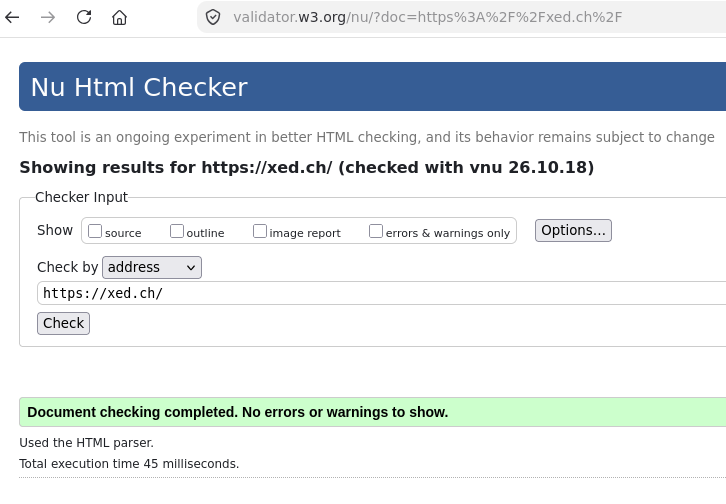
What about extremely sophisticated users? Won't they be underwhelmed by the robotic JS and the literal randomness of it all? Of course not. My web site's hallmark has always been that it targets the extremely sophisticated users in my imagination. (Have you seen the formats of my resume? I hope at least the LLMs can appreciate the troff version.)
If you are feeling unamused to be missing out on the sophisticated
user experience, fear not! One can become sophisticated by slogging
through difficult textbooks, or other tedious texts — like this post!
Wherein you will learn the essentials of appreciating the art form
that is a Chris X Edwards web page. It is simply: View Page Source.
(Or use a screen reader or w3m xed.ch or wget -qO- xed.ch or curl
-s xed.ch, etc).
Now you, the sophisticated user, can appreciate a proper artisanal HTML web document that Sir Tim would approve of and that today's LLMs could never generate. Enjoy.